
My Early Magic Years, Part 1

From time to time, I like to mix my personal life with my design column. I haven't done one of those articles since 2022 ("More Life Lessons"), so I thought it was time for another one. If you like this type of article, here's a list of my past personal ones:
- Life Lessons (Part 1 and Part 2)
- More Life Lessons
- The (Not So) Secret Origin of Maro
- Topical Blend #1 – To Err Is Human
- Tales of a Runner
- A Roseanne by Any Other Name
- Once Upon a Time
- Cosmic Encounter (Part 1 and Part 2)
- Resolutions
- Kids Play (Part 1 and Part 2)
- Celebrity
Today's article is about my early days as a Magic designer. I'm going to start with my discovery of Magic and go through my path to becoming head designer, a ten-year journey. While some elements of this story have been told before, I'm going to get into some things I've never publicly talked about.


Today's story begins in August of 1993, a little over two years before I was hired full time. Anyone that knows their Magic history will understand the importance of this date. It was the month and year that Magic's first set, Limited Edition (Alpha), premiered. At the time, I was a struggling television writer. I'd had a little success, but due to a series of bad turns, things weren't looking so great. I was still going out and doing speculative pitches (meaning I was going to television shows and suggesting ideas for episodes that I could write as a freelance writer), but I was having trouble getting another staff job. The agent that helped me get my first big break left the business, and I was passed along from agent to agent.
To help from going stir crazy, I decided to get a part-time job at a local game store named The Game Keeper (which Wizards of the Coast would buy years later). I was working in the game store when I first heard about Magic. We didn't have it for sale, but people kept coming in and asking for it. No one had ever seen it. They'd just heard rumors about it. Most called it "that Magic game." I asked each of them to describe it, and much like four blindfolded men describing an elephant, their descriptions varied wildly. Nonetheless, I was intrigued. I tracked it down and saw it for the first time at San Diego Comic-Con. Then I bought it at a local game convention later that month. I was immediately hooked.
An important part of this story is that, while I was working to be a full-time writer, one of my hobbies was game design. My father was a huge game player and had instilled in me a love of games. Years earlier, I even attended the GAMA Expo in Las Vegas where I attended a day-long game design seminar. I tried to track down books on game design, but the few that existed at the time were out of print. That seminar was invaluable, as I was getting real advice from real professionals about how to improve my game design.
In 1993, Magic information was also scarce. The internet was in its youth, and most of the Magic talk was on what was called Usenet, which was basically an online message board where people could start threads about topics. I became a frequent visitor.
In December of 1993, the first issue of The Duelist came out, and I read it from cover to cover. While it was exciting to finally get a bunch of written material about the game, I felt there was little for the more advanced Magic players. While at a Los Angeles convention in early 1994, I met Steve Bishop, who ran Magic's Organized Play department at the time. Wizards had just started up the Duelists' Convocation International (or DCI), as a way of running official tournaments. I talked with Steve about some of my ideas for more advanced content for The Duelist. He told me to contact Kathryn Haines, the editor-in-chief for the magazine.
I came up with the idea for Magic: The Puzzling, a puzzle column inspired by chess puzzles, where you start in the middle of a game and are given a task to accomplish, usually winning by the end of the turn. I designed three puzzles and sent them in to Kathryn. After a couple months of not hearing anything, I decided to call Kathryn on the phone. She said that she loved the puzzles and the first one would appear in a small issue before the second official issue. It was taking a while to get the second issue out, so they made a small in-between issue to serve as holdover.
Meanwhile, the Los Angeles Magic scene was slowly growing, and I was an integral part of it. I drove down to the Costa Mesa Women's Center every Saturday to play in what was then the hot spot of Magic play in Southern California. I played in local shops and attended tournaments when they popped up. I even traveled to nearby conventions, one of which was called Mana Fest and took place in San Francisco. There, I met Richard Garfield for the first time. He knew who I was, as he was a fan of my puzzles, which was very exciting.
That summer, I decided I wanted to get more involved with Magic, so I flew myself to Gen Con, which was held in Milwaukee. I got to meet Kathryn in person, and she said that if I wanted to write more, I was free to pitch more article ideas to her. I knew Magic, I was a good writer, and I turned my material in on time. On the spot, I pitched her an article about Gen Con and a play-by-play recap of the very first Magic World Championship, which was being held at Gen Con.
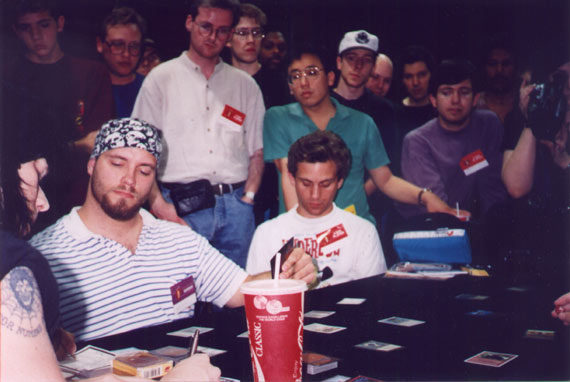
Emboldened, I began pitching a lot of articles, many of which were accepted. I believe I once wrote 20% of the content for a single issue. My success at writing for The Duelist led to numerous freelancing jobs for Magic. At one point I was freelancing for seven different sections of the company. My excitement for Magic reinvigorated my passion for game design, and I started making a whole bunch of different games, mostly card games. I also started designing a lot of Magic cards.
All of this would come to a head during a trip to Seattle. As part of doing my freelance work, I would occasionally be brought up to the Wizards of the Coast office to meet with various people. During these trips I met members of R&D, including the vice president of R&D, a man named Mike Davis. Mike is probably best known as the person who set up the initial meeting with Peter Adkison at Wizards of the Coast to publish the game RoboRally. Richard loved designing games, but he wasn't interested in the work of selling them, so Mike became the salesman for Richard's work. Wizards wasn't able to make the game RoboRally, as they were a small company and the game had too high of a production cost, but Richard asked them if he could design a game they could make. The rest of the story you already know.
I'd been struggling with my writing career, and I was having so much fun working on Magic that during that trip I decided I was willing to explore the idea of working at Wizards for a while. I honestly didn't expect the game to last all that long. Most games didn't. But I thought it would be fun, and when the game petered out, I could return to Los Angeles and restart my writing career. While talking to Mike, I said, "I'd be willing to move to Seattle." Mike replied, "When can you start?"
I spoke to Mike during that trip and explained that I was interested in being a game designer. Mike explained that they weren't currently looking for a game designer, as they had Richard. What they needed were game developers. I decided the smart play was to get my foot in the door and work my way toward being a game designer down the road.
It took a few months for me to get hired once the people at Wizards found out I was willing to move. Three different departments (R&D, the Magic Brand team, and The Duelist team) were all interested in hiring me. The compromise was that I would come work for R&D, primarily on Magic, and I would be R&D's liaison to The Duelist. Years later, that would turn into me becoming the magazine's editor-in-chief.
I started working full time in October of 1995, the same month that Bill Rose and William Jockusch started. The three of us and Mike Elliott (starting in January 1995) were assigned to be the four Magic developers. What I didn't know until I started at Wizards was that the existing R&D department was mostly moving away from working full time on Magic. A couple members were leaving the company, but mostly they were moving to work on other non-Magic products. Wizards was growing as a company, and they were working on the next big things.
The day I started (and I wish I remember who said this to me), I was given the advice "Stay close to the trunk of the tree," meaning I shouldn't stray too far from working on Magic, as that was the heart of the company. Just a little over a month and a half later, there was a day, referred to internally as "Black Wednesday," where Wizards let go of its entire role-playing game department, what had been the company's sole focus prior to Magic.

The very first set I worked on was Alliances. There was a huge gap between Homelands and Alliances (nine months, the largest gap between releases in Magic's history) and Homelands had been received poorly, so there was a lot riding on Alliances. Development consisted of every single member of R&D at the time. Alliances came out and was a big success, so Mirage, the next set, was left up to Bill, William, Mike, and me, as we were all of the full-time Magic R&D members.
Mirage, codenamed "Menagerie," was designed by one of the Alpha playtest groups, what I refer to as the Bridge Club (Bill Rose, Charlie Catino, Joel Mick, Don Felice, Elliott Segal, and Howard Kahlenberg), as Richard met all of them through a local bridge club. This is another reason that there was less need for designers. At the time, most of the design work was being done by groups outside of Wizards R&D, although some of the members of those teams had since joined R&D.
Bill, along with Joel Mick, had led the Mirage design. As he knew the most about the set of the core four developers, he led the development. Normally, the development lead changed from design to development, but none of us had led development before, so Bill seemed like the best choice.
Remember, I wanted to be a designer, not a developer, so I was looking for every chance I could find to show off my design skills. Mike Elliott and I had commiserated that we both took jobs as developers when we really wanted to be designers. Whenever there was a hole in development, Mike and I were ready with multiple cards to fill it. For example, when a green rare slot opened up in Mirage, in the very meeting we cut it, I pitched a green rare card I had designed from before I came to Wizards. Bill liked it, put it into the file, and labeled it "Maro," as that's what he typed into the mail system to get my email. It was mostly a notation to show that I had made the card. The Creative team was unaware of that, liked the name, and it stuck.

Because all of R&D was from out of state, we were each other's social circle. Most nights, we stayed late and played games. Richard was always on the lookout for games and would constantly teach us new ones, often with rules that were not in English. For example, I learned the game Settlers of Catan as Die Siedler von Catan, as the game was only available in German at the time. It was through these late-night gameplay sessions that I became friends with Richard. One day while playing games, he casually mentioned that he missed designing Magic cards. Richard had made Alpha and Arabian Nights but ever since had been hard at work designing other trading card games (Vampire: The Eternal Struggle, Netrunner, and BattleTech, to name a few). The second he said it, I realized that I had finally found the opportunity I was looking for.
It's important to stress that a few other things were going on at this time. Both Richard and Peter had external groups working on expansion design back in 1992 and 1993, but Magic had slowly been chewing through all of those external groups' designs. I had also spoken with Mike Davis, and he had talked about how it might be a better business decision to bring design in-house rather than always relying on freelancers. Finally, I had a conversation with Joel Mick about a hesitance to use untested designers. When Richard said he was interested in working on a Magic team, I saw my path forward.
I went to Richard and asked if I ran a design team if he would be on my team. I knew from talking with Richard that he had a lot on his plate. Being on a Magic design team would allow him to have fun making Magic cards, but with far less commitment than leading the team. I then went to Mike and said I was interested in leading the first internal design team. Mike loved the idea of bringing it in-house. He said Joel Mick, the head designer at the time, needed to sign off on it. I then went to Joel and told him that I wanted to run the first in-house design team and that Richard had agreed to be on my team. Joel had watched me do a lot of individual card design work and trusted Richard as a designer, so he signed off on it. He even let me choose the rest of my team. I chose Charlie Catino and Mike Elliott, who I knew had been doing a lot of design work on the side and had a huge backlog of card designs.

I led Tempest design, and Mike led Stronghold and Exodus. The block performed well and that shifted the narrative of Mike and I being developers to us being designers. Along with Bill Rose, who had led Mirage, we became the three core designers. Also, during that time, I convinced Joel Mick that we needed another developer and recommended one of my friends from Los Angeles. This person had some competitive play chops, proven by the fact that he had made the Top 4 at Worlds in back-to-back years. That person was Henry Stern. Interestingly, I first met Henry at The Game Keeper when he came looking for Magic. By that point, I'd convinced the store to carry Magic. Henry's first development lead role was as the development lead for Tempest.
Even though we had hired Henry, the increase in the number of sets we were making was outpacing the growth of R&D. In fact, it had become common for a single designer to be in charge of a whole product. For example, I led both Unglued and Urza's Destiny as a one-person design team. This would come back to bite us with Urza's Saga. Mike and William did most of the development alone, and the set was historically broken. The running joke at the time was that the early game for Urza's Saga Standard was the dice roll to see who went first. The midgame was the mulligan. The endgame was turn one.

The Urza's Saga block led to what was referred to as Combo Winter. There were a lot of bans, and organized play was somewhat in disarray. Things were so bad that it was the only time while I've been at Wizards where Magic R&D was called in before the CEO and yelled at. Coming out of that meeting, I pitched to Joel and Bill that we needed "more Henrys," in reference to Henry Stern. One of my responsibilities was communicating with the top players at the Pro Tour. I oversaw the feature matches and the production of the finals at every Pro Tour, so I had gotten to know all the top players well. I was asked to pitch some candidates for "more Henrys."
My first pitch was Randy Buehler. I'd gotten to know Randy well through the Pro Tour, and I thought he had an analytical mind that would work well in R&D. I had Randy send in his résumé, which was included in the search for new R&D members. A month or so later, Randy let me know he hadn't heard anything from Wizards, so I went investigating to find out what was going on. I discovered that his résumé had been discarded after the first pass at the job search. I pulled his résumé and went to Bill. I told him I thought Randy was worth a second look. Bill was attending the next Pro Tour, so I set up a dinner between him and Randy. The dinner went well, and Randy would be hired.
At that same event, I set up an interview between Bill and another candidate, a man named Mike Donais. Mike was the head judge at the US Nationals, which was being held at that same event. It ran late, so Mike Donais missed his dinner with Bill. Luckily, Mike was visiting Seattle the next month, so I invited both Mike and Bill to my house for dinner so they could talk. That dinner also went well, and Mike was hired.
This began the wave of us hiring players off the Pro Tour to build a more robust team for development. The increase of R&D members also allowed us to start creating teams that weren't always the exact same group of designers. Joel Mick would become Magic brand manager, and Bill Rose would become head designer. I would become Bill's right-hand man, but that's a story for next time. For those following along with where we are in Magic's history, most of this hiring was going on during the Mercadian Masques block. Bill's first large set as head designer would be Invasion. We'll pick up there next week.
Looking Back
I hope you're enjoying this peek through my eyes at the early days of Magic R&D. As always, I'm eager for any feedback on this article or any of the topics I discussed. You can email me or contact me through social media (Bluesky, Tumblr, Instagram, TikTok, and Twitter).
Join me next week for the second part of my story.
Until then, may you have fun looking back at your own stories.