
Giving the Players an Edge, Part 1

Welcome to the start of Edge of Eternities previews! Today, I'm going to introduce you to the set's Vision Design team, begin the story of the set's design, and show off a cool preview card. Let's get to it.
The Cutting Edge
Before I get to the story of the set's vision design, I want to introduce the team. As always, the team is introduced by the vision design lead, which for Edge of Eternities was Ethan Fleischer. Ethan had been pitching a space set for years, so he was my clear choice to lead the Edge of Eternities Vision Design team.
-
Click here to meet the Edge of Eternities Vision Design team
-
Ethan Fleischer (Vision Design Lead)
Ethan has led many design teams over the years. Recently, he has focused on guiding our design philosophy for Universes Beyond sets. As a huge fan of the space opera genre, he jumped at the chance to lead the vision design team for Edge of Eternities.Jeremy Geist
Jeremy made a name for himself in The Great Designer Search 3 and quickly impressed Studio X with his design skills. Jeremy's role on the Edge of Eternities Vision Design team was to design lots of cards, a role at which he excelled at. This was, of course, years ago. Now, Jeremy leads vision design teams of his own.Mark Rosewater
As Magic's head designer, Mark serves on most of the major vision design teams so that he can oversee the process. Mark's years of experience are a great asset when it comes to evaluating major design elements like keyword mechanics. He hasn't seen it all, but he's seen a lot!Megan Smith
When Vision Design began, Megan had recently transitioned from the Magic Spellslingers Design team to the Magic design team. Megan had plenty of experience playing Constructed Magic, but she was still learning the ropes when it came to Limited. Her main role on the Vision Design team was to learn about how those teams operated. It must have worked; she has since graduated to leading her own design teams.Dan Musser
Dan was the manager for the Play Design team. When we were designing Edge of Eternities, he served on every Magic Multiverse set's vision design team. This broad perspective allowed him to identify potential areas of duplication or conflict between sets that were going to be released near each other in the calendar. Dan has since left Wizards of the Coast.Doug Beyer
Doug is one of our most experienced worldbuilding designers and an excellent game designer to boot. He served as the vision creative lead for Edge of Eternities, alongside Narrative Lead Miguel Lopez. At its best, game design inspires worldbuilding, and worldbuilding inspires game design, in turn, in a virtuous circle. Edge of Eternities's design process exemplified that ideal, in no small part due to Doug.Andrew Brown
Andrew is the technical lead for the Play Design team, having come to Wizards off the Pro Tour. Edge of Eternities was the first time that Andrew led a set design team. Before that, he served on the set's vision design team. Andrew's passion, coupled with his understanding of what a set needs to succeed in Limited and Constructed, made him a stand-out member of the Vision Design team, setting Edge of Eternities up for success in the later stages of the design process.On The Edge of Glory
Our story begins with Bill Rose. Bill was one of the original Magic playtesters, part of the group known as the "Bridge Club" because they met Richard Garfield playing bridge together. He led the design for a set codenamed "Menagerie" which would become Mirage and Visions. Bill started in R&D three weeks before me. He would go on to become the vice president of Magic. The reason we made a space set was because Bill said "We should go to space."
Initially, Magic was focused on high fantasy, but over the years we've pushed into different genres while keeping that fantasy aesthetic. Magic has definitely had elements of science fiction, but we'd kept to planes and not ventured into space.
For years, we've talked about the idea of doing a set that takes place in space, but decided against it. This wasn't because we didn't think it would be cool or that we couldn't execute it well. Mostly, it was because we worried players wouldn't accept it as Magic.
I chose to put Unfinity in space because of how many times a space set had come up and we had decided against it. I hoped that by making a set in space, we could demonstrate how Magic could incorporate it. For example, the lands set in space were wildly popular.
The idea of doing a space set came back as a result of our return to Kamigawa in Kamigawa: Neon Dynasty. We wanted to create a setting that was influenced by Japanese pop culture. We ended up making that setting Kamigawa and playing into a theme of the past versus the future. This encouraged us to make a portion of the set more futuristic than we had ever done before. The audience adored the set, and it made Bill realize that we could be more adventurous when it came to approaching science fiction and science fantasy. I pointed out that most space opera stories were mainly fantasy stories with a science-fiction aesthetic. That inspired Bill to say "We should go to space."
This led the Arc Planning team to explore what a space set would look like. We realized that there were many different sub-genres of science-fiction stories set in space, so we spent some time dividing them up. The idea was that if this set went well, we could return to space in the future. This helped us keep things distinct. The obvious first choice was space opera, because as I said above, it's the closest to fantasy. The set does have tiny nods to some of the other subgenres we might explore in the future.
The other thing that was very important to the Arc Planning team was imbuing the set with Magic. The guiding topline for the set was "Magic goes to space," meaning we wanted the set filled with core Magic principles and Magic elements. We did this in two ways. First, we started our worldbuilding with Magic's color pie. On Theros, the color pie is used to show off the gods. On Eldraine, the courts. On Innistrad, the monsters. What was the most space opera thing we could show through the lens of the color pie? We chose planets.
A core part of this genre space is the idea that there are different planets each with their own inhabitants. The contrast between the worlds and their inhabitants are a big part of space opera. The white-mana planet, for example, would embody the Magic color white's philosophy of peace and order.
Second, we wanted to make sure that we were filling the set with things associated with Magic, albeit in the trappings of space opera. The most obvious place to do this was with the different space creatures. Rather than inventing a lot of brand-new creature types, most creatures in the set use existing creature types with a new creative treatment. There are Kavu, Jellyfish, Insects, Plants, and more. Things that allow us to make new species of aliens with an underlying Magic feel. With these ideas in mind, we greenlit the space opera set.
On Edge
We began designing Edge of Eternities—codenamed "Volleyball"—by filling a whiteboard with all the tropes of the space opera genre. The reason we start by focusing on broader genre tropes is to get a sense of what players would expect of set that was "Magic goes to space." An important part of this exercise is understanding what aspects of the potential setting deviate from the norm. What parts of the space opera genre don't neatly fit into what Magic already does? For example, a space opera wants a lot of different types of aliens, and Magic is already filled with different kinds of creatures with varying abilities. Capturing a sense of aliens, for example, wouldn't be hard. So what would Magic have trouble capturing?
We found one of the harder things to capture was scope. The scale of things in the space opera genre is so much larger than a normal story. Narratives don't span cities, they span planets. Travel isn't done with cars, but giant spaceships. While there are normal-sized creatures, there are also abnormally large ones. How would the set be able to capture the giant scope of a space opera?
During exploratory design and early vision design, we tried different ways to convey a large scope in Magic. We talked through a number of ideas, but one in particular captured our fancy. Years earlier, I did something I don't do often. I worked on the design of a game other than Magic. We were designing a new Transformers trading card game, and many of our designers hadn't developed new trading card games. I was asked if I could join the Transformers team, and luckily my schedule allowed it. One of the things that the Transformers trading card game did was print larger cards. The base cards of the game were the same size as Magic card, but each pack came with one large card, basically the size of two standard-sized cards.
While working on solving the scale problem in Edge of Eternities, I remembered the giant cards from the Transformers trading card game. If we wanted to communicate scope, cards that were twice the size of normal cards certainly did that. We dubbed them cosmic cards (with the idea that they've have the supertype cosmic). We made giant spaceships, planets, space phenomenon, and even a few humongous creatures.
We tried a lot of different designs for cosmic cards. In the end, the design we liked the best had a track on the card, with the cards themselves being horizontal. Each card would tell you how to advance the track, with the card gaining abilities as it advanced along the track
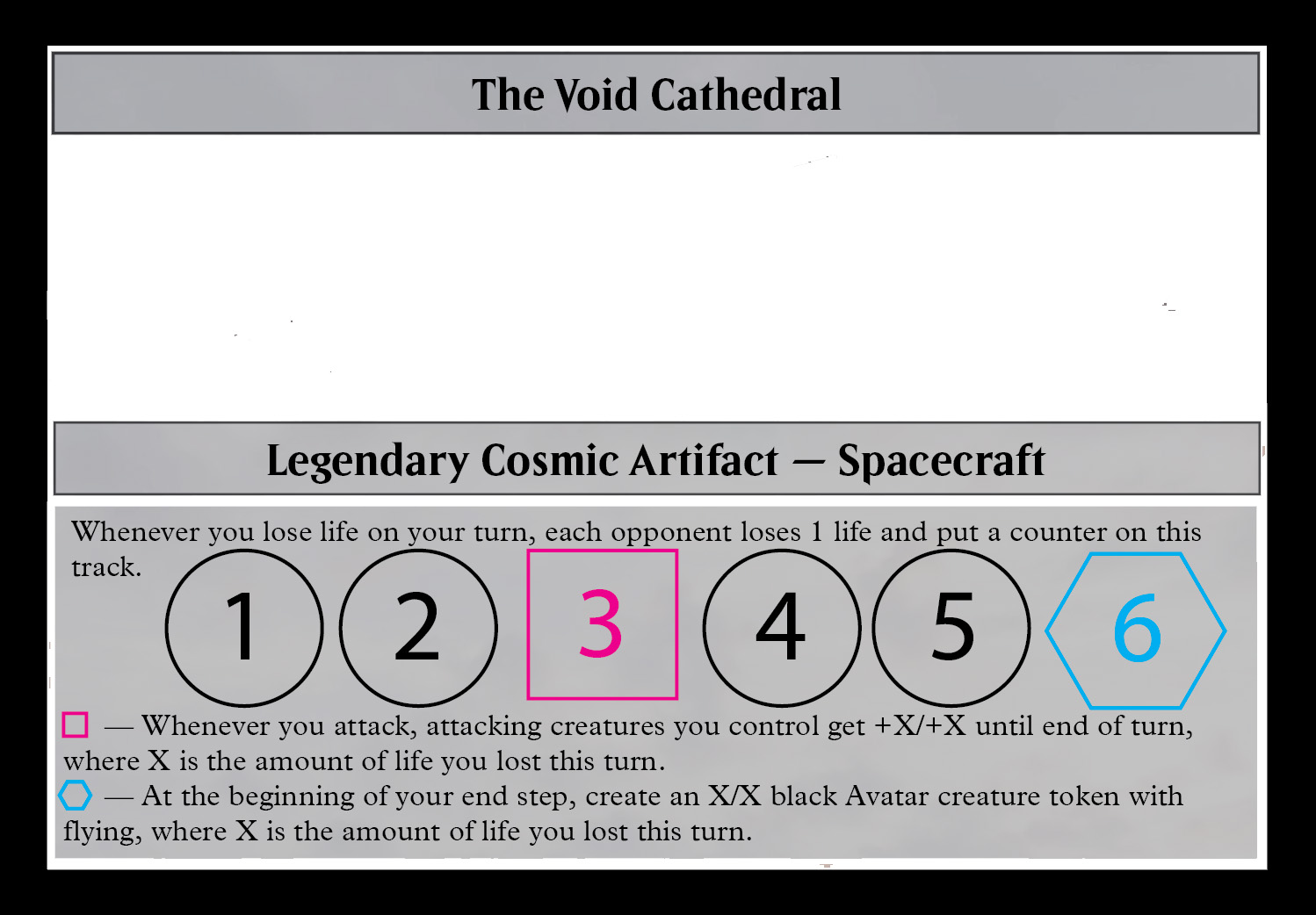 A playtest cosmic card from "Volleyball" Vision Design
Because the cards were too big to fit in the deck, we had cards which would fetch them. We originally tried cards that fetched other specific cards, but as we found when we tried the same thing with double-faced cards (or DFCs) in the original Innistrad block, it's still too hard to have two different cards always show up together in a booster. We ended up making cards that could get any cosmic card of a certain color and put them in the file at a high enough as-fan that players would have access to them in Limited.
We liked how the cards played, and everyone was excited about the giant cards. We created playtest versions of the cards at the "Volleyball" Vision Design Summit so everyone could play with the cards at the actual size they would be in the final product. Our plan was to make the Play Boosters bigger and have them include one cosmic card per Play Booster. I'm sad to say when you open Edge of Eternities, you won't find any cosmic cards. In short, there's a big difference in how we produced a smaller game like the Transformer trading card game and a game as big as Magic. Ironically, the item we put into the set to represent the giant scale of space opera itself couldn't handle the scale difference needed for Magic.
We didn't find out that the cosmic cards would have to go until set design, so I'll talk about how that change led to the station mechanic next week.
Now let's move onto the other mechanics.
Warp
0077_MTGEOE_Main: Starbreach Whale Space opera media tends to have a lot of teleporting and hyperspace travel, so we were interested in capturing that flavor. We ended up creating a mechanic that borrowed from two previous popular mechanics: evoke creatures and Adventure spells.
I created the evoke mechanic while designing Lorwyn. My original goal was to make instants and sorceries that you could turn into a creature for an additional cost. Magic's rules don't play nicely with instants and sorceries becoming permanents, so we took a different approach. Evoke was used on creatures with abilities that triggered when they entered or left the battlefield. Evoke was an alternate (usually cheaper cost) that made you sacrifice them when they enter. This captured the feeling of the original instant and sorcery mechanic: you could get a spell for cheaper or the spell along with a creature for more mana.
Adventure was created by the Throne of Eldraine Set Design team. They were trying to find a way to get more spells into the set and came up with the idea of spells stapled to a creature that you could cast later. This mechanic was loosely based on Amonkhet's aftermath mechanic, where you essentially got a split card where you cast one side from your hand and one side from the graveyard. Adventure spells let you cast the Adventure spell or the creature from your hand. If you cast the Adventure, which was usually cheaper, you could cast the creature later. If you cast the creature, you no longer had access to the Adventure.
Both Adventure spells and evoke creatures were very popular when they first appeared. We've reused Adventure numerous times and have looked at bringing back evoke in multiple sets. We liked the idea that you had the option to cast the spell for less mana like evoke, but also the layaway creature from Adventure. So, we took that aspect of Adventure spells and added the spell-like enters abilities of evoke. Here's how the mechanic worked as handed off from Vision Design:
Warp COST (You may cast this spell from your hand for its warp cost during your precombat main phase. If you do, exile it at the end of combat. You may cast the card for as long as it remains exiled.)
The basics of the mechanic are there, but a lot of the details differ from the printed version. Next week, when I talk through set design, I'll explain what changes we made and why.
Void
0097_MTGEOE_Main: Elegy Acolyte Warp went on creature cards and cosmic cards were all permanents, so we were looking for a mechanic that could go on instants and sorceries. For inspiration, we looked to the Monoists, a black hole-worshipping organization that Worldbuilding had created. This meant it wanted to have a flavor of caring about destruction. Whenever looking for a mechanic, we often look for what existing mechanic fills the shape we need. The answer was morbid.
Morbid can go on permanent cards, instants, and sorceries. It cares about zone changes. It can create dynamic gameplay that gives new depth to combat. But, morbid had three problems for this set. First, the name wasn't a good flavor fit for the set. Second, it only cared about creatures, and we wanted it to care about other permanents. Third, it only cared about things entering the graveyard. We had a whole mechanic, warp, that exiled permanents.
The solution was to make a new mechanic. We called it void. It similar to morbid but cared about your creatures or artifacts dying or being exiled. Here's the version that Vision Design handed over:
Void — If an artifact or creature was put into a graveyard or exile from the battlefield this turn, EFFECT.
Like warp, void mostly stayed the same but had some incremental changes, which I will run through next week when I talk about set design.
Lander Tokens
0138_MTGEOE_Main: Kav Landseeker Space opera media tends to revolve around advanced technology, so we liked the idea of creating a new artifact token. Artifact tokens would work well with other themes, like "artifacts matter" and sacrifice themes, which were both themes we wanted in the set. From there, we looked for problems that artifact tokens could solve. We asked what the set needed and realized it needed mana fixing. Could we make a new artifact token that fixed your mana?
The biggest challenge is we only wanted to make a single artifact token. The Lost Caverns of Ixalan had experimented with five different artifact tokens in early design, but that ended up being too complex. Artifact tokens work best when a set has one singular token. We were also interested in exploring the double-faced token technology we'd used on the incubate mechanic in March of the Machine.
After some trial and error, here's what we came up with. The front side would be an artifact with a cost. When you activated it, the artifact would transform. Because we didn't want pure color fixing, we made the back side an artifact land with Star Compass's ability: it could tap for any color you could already produce with your other lands.
Create a Lander token. (It's an artifact with "{o2}, {oT}: Transform this artifact." It transforms into a Settlement artifact land token with "{oT}: Add one mana of any type that a land you control could produce.)
You can see a theme emerging in today's article. Vision Design got close, but there were some issues that Set Design had to work out. Lander tokens changed more substantially than warp or void, but the final version still hit the basic function of Vision Design's original proposal. Next week, I'll walk through all the changes.
The Returning Mechanic
0233_MTGEOE_Main: Tannuk, Memorial Ensign Edge of Eternities has a returning mechanic that shows up on twelve cards: landfall. Vision Design did recommend we use a returning mechanic, but not the one we landed on. Vision Design proposed using something modified from Kamigawa: Neon Dynasty. Space opera media has a lot of tropes involving weapons and tools, so we explored the idea of creating a draft archetype that cared about Auras, Equipment, and counters. As I'll talk about next week, that returning mechanic would change, becoming landfall.
Flavorful Space Opera Designs
While it's not a mechanic, Vision Design spent a lot of time creating cards that captured the look and feel of space opera media. My preview card today is one of these.
-
Click here to see Weapons Manufacturing
-
0168_MTGEOE_Main: Weapons Manufacturing 0311_MTGEOE_RsoSpa: Weapons Manufacturing This is the one other noncreature artifact token in the set, and it only appears on this card, a rare. We wanted a card that represented the manufacturing of weapons, and we liked having it tied to an artifact strategy. While Lander tokens are the main artifact token of the set, we do allow one-off tokens on high rarity cards. The fact that the Munitions tokens have a death trigger means that players have to find a way to sacrifice or destroy those tokens, which makes for a fun build-around card.
Leaving You on the Edge
That's all I have for today. As you can see, Vision Design got the set going in the right direction, but Set Design still had a lot of work adapting the mechanics. In addition, the cosmic cards would be cut during set design, which meant we needed a new mechanic to fill that slot. I'll cover that process next week.
As always, I'm eager for any feedback be it on today's article, Edge of Eternities, or any of the mechanics I talked about. You can email me or contact me through social media (Bluesky, Tumblr, Instagram, TikTok, and Twitter).
Join me next week for part two.
Until then, may you have fun exploring the Edge.
-