
Under the Mask with Magic: The Gathering® | Marvel's Spider-Man Creative Design

Greetings, True Believers. Join us for a swing through our creative approach to developing Magic: The Gathering® | Marvel's Spider-Man!
Under the mask, I'm Aaron Mesburne, a senior narrative game designer on the Universes Beyond team. I've been a big fan of Spider-Man since I was a kid in the mid-90s. Some of my earliest memories of the wall-crawler include playing Marvel video games on a local store's arcade cabinet and paging through The Amazing Spider-Man: Look and Find book. (Does anyone else remember the underground lair page full of Spidey clones?) I'm also more than happy to share my belief that Sam Raimi's Spider-Man and Spider-Man 2 are still some of the best Super Hero films of all time.
Now, with that origin story behind us, let's explore some of the challenges and thinking that went into this set's creative development.
Editor's Note: For a deeper dive into how the design teams approached Magic: The Gathering | Marvel's Spider-Man, check out the following articles by designers Mark Rosewater, Corey Bowen, and Eric Engelhard.
Building a Marvel Universe: An Interconnected Web
It was an honor to act as the narrative lead for Magic's initial handful of Marvel releases. Our first foray into the Marvel Universe was a series of Secret Lair drops themed around Captain America, Iron Man, Black Panther, Wolverine, and Storm released in late 2024. The Secret Lair x Marvel's Deadpool drop came out earlier this year, and there was even a promotional
Regardless of product, my worldbuilding approach treats all Marvel-themed Magic cards as pieces of a grand Marvel tapestry that we began to weave in earnest with Magic: The Gathering | Marvel's Spider-Man. It has been a privilege wielding the great power to shape cards inspired by beloved Marvel moments and characters, and with that power, our entire team felt a sense of great responsibility to deliver a faithful vision, not just of the Spider-Man mythos, but of the Marvel Universe as a whole.
From the time we began to seriously spin up the collaboration, it was clear that adapting Marvel to Magic: The Gathering was going to be a unique challenge. Unlike prior Universes Beyond projects, Marvel and its vast shared universe of characters and stories built up over generations could only be tackled as a multi-set endeavor. Anything less would be a disservice to the franchise and the fans who love it. So, while Spider-Man is the first set we are releasing, it is the start of our growing Marvel Universe depicted within Magic: The Gathering, and we made choices reflecting that.
Spidey Smorgasbord
Like the greater Marvel Universe, the Spider-Man franchise is a constantly evolving and ongoing media landscape. Generations of fans have come to love it through countless stories: comics, television series, films, games, and more. Given these diverse portrayals of the web-slinger, we felt it was important for our set to feel broadly relevant and welcoming to a wide range of Spider-Man fans, both now and into the future.
So, we took an anthology approach to the set, aiming to represent a wide range of characters, moments, places, and objects from many eras of Spider-Man. Because of the set's size and development needs, we made the choice to take inspiration only from existing Spider-Man stories rather than inventing a new narrative for these cards.
While this set is based on Marvel Comics and includes a healthy amount of deeper lore, we did consider whether a given story element had been adapted in other popular media when ranking our inclusions so that more fans of Spider-Man would see something they recognized. In terms of character design, we choose to take what I call a "Timeless Toybox" approach: keeping our main visual depictions of the characters and their world true to more recognizable "evergreen" designs from the comics.
A Gallery of Heroes and Rogues
One of Marvel's greatest strengths is its vast library of characters, so determining who to include was one of our biggest hurdles. We knew our set was going to be primarily based on the Spider-Man comics, and we brainstormed long lists of potential characters we knew fans would love to see here. These characters ranged from Spider-Man comic mainstays to notable character cameos within the Marvel Comics archive, and even beyond to depictions of Spider-Man and his associates from many other forms of media. To reach our final list, we worked closely with our helpful friends at Marvel to determine which of their characters were in bounds for our Spider-Man product and which characters could potentially be deployed later.
Can a Legend Be Nonlegendary?
After determining our potential character list, we ran into our first big problem: there are way too many characters who deserve to be legendary creatures and there's not enough room for all of them to be legendary in our smaller set. Given this reality, we made some hard choices aimed at ultimately including as many fan-favorite characters on cards as we could. Below are a few such characters and our approach to adapting them as nonlegendary creatures:
Selfless Police Captain (Captain Stacy): We knew we needed to include Captain Stacy and his notable self-sacrifice somehow in the set. Interestingly, the impact of alternate Spider-Verse storylines across both comics and film has led many fans to view the "Self-Sacrificing Police Captain" as a reoccurring trope in the wider Spider-Man mythos. Making our depiction of Captain Stacy a nonlegend that reflected this general Spider-Man media trope is an approach that hopefully feels resonant to Spider-Man fans of all eras.
Daily Bugle Reporters (Robbie Robertson, Ben Urich, and Betty Brant): Spider-Man's more everyday supporting cast is important to include. I personally wish we had room in our set to make legendary creatures out of all these classic characters, but it felt appropriate to group them all on our common creature card representing the folks of the Daily Bugle offices.
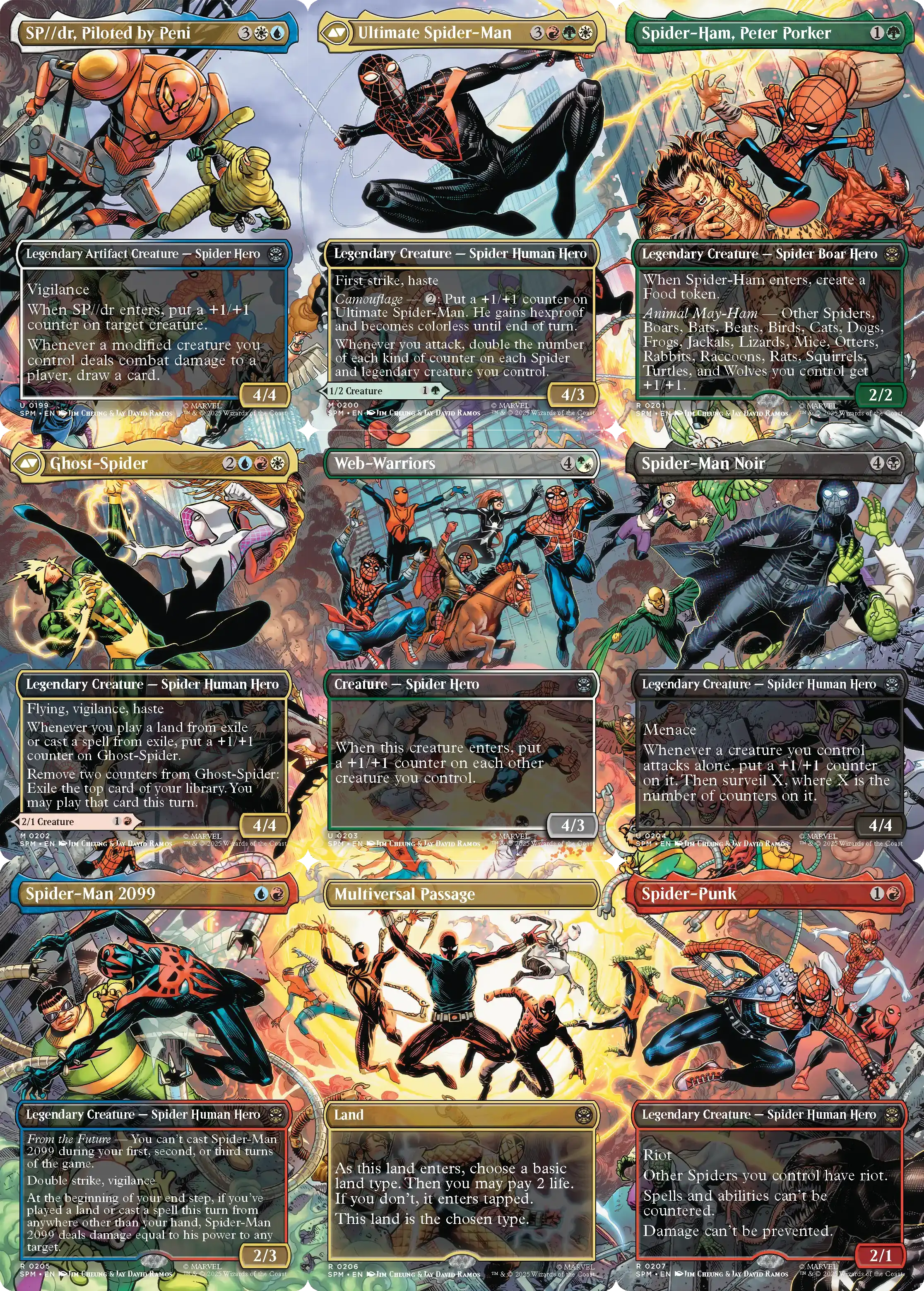
And when there wasn't an appropriate creature card slot, we still aimed to include Easter eggs of lesser-known Spider-Man characters wherever we could. The nine-card scene features many of these cameos, and eagle-eyed Spider-Man fans may be able to spot some familiar faces on spells like
Type-Casting
Creature types were a huge topic of discussion during the development of Magic: The Gathering | Marvel's Spider-Man. The massive pop culture presence that is Marvel meant that there were more people in the room who knew these characters and had opinions about them. On top of that, many characters in Marvel have long and varied histories that support lore-based arguments for why their Magic card could possess a whole host of creature types. For example, here is a hypothetical, impossibly long type line for Doc Ock with all the types we considered for him:
Legendary Artifact Creature — Octopus Human Mutant Cyborg Artificer Scientist Rogue Villain
However, our card type lines have only so much space. As with many Universes Beyond sets, we ultimately had to make creature type choices based on the relevant lore, art, and game design needs of each individual card. Below, I've listed a few notable creature types in this set along with some info about our approach to these subtypes:
Hero and Villain: Starting with the Marvel Secret Lair drops and continuing into this set, Hero and Villain subtypes are shaping up to be one of the major throughlines of our Marvel collaboration. The core narrative conflict of Super Heroes versus super villains in Marvel media was just too on-brand to pass up. In some cases, a subtype like Hero may better reflect a character's in-universe "job" or role in the story than other typal words that Magic has used in the past. That said, there are certainly Marvel characters who have acted as both Super Heroes and super villains over the years, and we sought to represent these shifting motivations where we could. For example, while Doc Ock is traditionally a villain, his
Another interesting case is Venom, who started out largely as a villain but has become more of a true anti-hero. This history is expressed with our common Venom creature, which has the Villain subtype, whereas the mythic rare
Citizen: As a contrast to characters who fit the Hero and Villain subtypes, this returning creature type was a great flavor tool to characterize and group the more civilian denizens of New York City in a way that made perfect sense for our setting.
Spider: In this setting, overwhelmingly, if a creature is a literal spider or has been modified by a radioactive spider bite, other spider DNA, or something similar, they get the Spider creature type. The Spider-Verse, however, is vast. If you go looking for them, there are a small number of cards with the Spider creature type in our set for whom their spider connection is more thematic or nebulously supernatural. These few edge cases, such as
Other Animal Subtypes: Saying a lot of characters in Spider-Man media like to dress up as animals is a massive understatement. To help solve difficult creature type line restrictions with some consistency, we tried to maintain the same threshold we used for cards with the subtype Spider: only characters who were physically imbued with the powers of a given animal get that creature type. For example, the character Scorpion (Mac Gargan) has the Scorpion creature type in our set because he canonically got some of his powers from an experiment involving scorpion DNA. On the other side, a character like Vulture (Adrian Toomes) doesn't have the Bird creature type in our set because, despite his thematic power of flight and animal-like costume, his traditional abilities in the comics come from technology, not sort of literal bird-derived modification to his body.
Goblin: In this setting, if a creature has been modified by some version of the Goblin Formula they get the Goblin subtype. And, at the end of the day, we are making Magic cards, and we felt it would be a real shame to deprive Goblin typal decks of some of the most famous Goblin-titled characters in all of fiction.
Symbiote: This is another new creature type. When thinking about the Venomized characters, we considered existing subtypes like Alien or the more recent name for their species, Klyntar, but we ultimately decided that the word symbiote struck the best balance of being both flavorful and more recognizable to Spider-Man fans of all backgrounds. Perhaps we'll see more cards with the Symbiote creature subtype in the future.
Rogue: Why do some creatures in this set have the Rogue subtype when Villain exists as a potential catch-all subtype for folks with a roguish disposition? We did this partially to provide some backward synergy and deck-building hooks for existing cards that care about the Rogue subtype. Additionally, the Rogue subtype further embodies some characters who are specifically known for their thievery (Black Cat says "meow").
Mutant: At Mark Rosewater's request, creatures with the Mutant subtype in Marvel sets are characters who canonically have an X-Gene. As you may have noticed, they also notably don't get the Human subtype as a nod to how mutants are viewed as an othered group from baseline humans in the Marvel Universe. While this set only adds two Mutants (bringing our current roster of Marvel mutant creatures to five), keep an eye out for more Marvel mutants in future releases!
Creative Text
Every Universes Beyond set has a different approach to its creative text depending on the media itself and the collaborator's input. Our friends at Marvel were generous and flexible in this area, so our creative text ended up being a solid mix of quotes taken from the Marvel Comics library and new text by our writers.
For text not taken directly from comics, we still aimed to channel Marvel's style in our set. We took inspiration from Marvel's practice of snappy, alliterative naming and added this kind of iconic alliteration to our card names wherever it made sense. We also felt it was important to incorporate the voice of Spider-Man, and his penchant for self-narrated action, thoughts, and wisecracks, throughout the set's flavor text.
Shoutout to our sensational editor, Matt Tabak, who triple-checked all our comic-derived text with the source material.
You may also notice some variations in quote attribution in this set. Errors do happen, but these sorts of attribution variations are generally intentional here because Spider-Man media is known for characters with both civilian and costumed personas:
If a character's quote is attributed to just their civilian name (e.g., —Peter Parker), this character is speaking out of costume or in their more civilian form.
If a quote is attributed as "Costumed name, Civilian name" (e.g., —Spider-Man, Peter Parker), it means that this specific version of that character in costume is saying the text.
There were also handful of cards where we realized that the art or text source didn't necessarily imply a specific character named Spider-Man was speaking a given quote, so to open up the possibility among readers that any costumed Spider-Man (Peter, Miles, and others) could be the speaker, we just attributed these quotes to just "Spider-Man" with no civilian name specification.
At one point, we also briefly explored the idea of noting meta-lore details on cards, like the source comic issue number or the Marvel Multiverse Earth Number (Earth-616, etc.) for the moment or character depicted. These would have either been part of the flavor text or placed in the bottom-left corner of the card. I'm a big fan of giving players info they can use to go to learn more about the visuals and story being depicted on a given card, but these sorts of addendums proved a bit too wordy here. A few Earth number callouts did make it to print on cards like
Bring Me Pictures of Spider-Man!
For our main set art, we chose to stick very closely to the original designs from the comics and have artists render Magic's vision of Spider-Man in the same style that we use for normal Magic sets. A couple of my favorite pieces in the set from returning Magic artists are Ryan Pancoast's stunning version of a famous comic book moment* in
*Editors note, see Amazing Spider-Man #33.
Our art directors also managed to squeeze some spectacular comic artists into the artist roster for this set. Two of the comic luminaries that I was most excited to see our art director, Mike Thomas, bring on were Paolo Rivera who illustrated cards like
In contrast to the main set, we largely reserved comic-style art for Booster Fun treatments. I'd like to shout out Tom Jenkot and the rest of the Booster Fun team for delivering some of the most exciting treatments to date with their panel card Sagas and captivating classic comic versions of
And last but certainly not least, we used source material cards to deliver even more comic goodness into the set. Getting to pore through the Marvel archives to find fitting moments to match reprints from across Magic history was a true delight and gave us a chance to showcase even more nostalgic Spider-Man artists and visuals. You can see some of my favorites here.
New York City
While Magic: The Gathering | Marvel's Spider-Man does at times venture out into the Spider-Verse, this is our first Universes Beyond set that primarily takes place in a modern, real-world location.
We kept our NYC cityscapes generic and aimed to include visual trappings of NYC in other ways. There are vehicle-themed cards like
Lastly, due to the size of the set, Magic: The Gathering | Marvel's Spider-Man only has two cycles of basic lands, whereas a typical set often has three or four. This constraint was perhaps a blessing in disguise that forced our best ideas to the top. Our web-swinging Spider-Man lands show us the city from Spidey's perspective with a bit of wide-angle, cinematic grandeur.
I'm also particularly proud of what our team accomplished with our Booster Fun cycle of full-art basic lands: the spiderweb lands! Inspired by the iconic Theros Beyond Death lands, this cycle is, in my humble opinion, one of the best expressions of merging Magic and Spider-Man brands into game pieces that we hope players will love for years to come!
Harnessing the Infinity Stones
To finish out our journey through the creative side of Magic: The Gathering | Marvel's Spider-Man, I would be remiss not to say something about one of perhaps the strangest cards in the set:
We had to fit one Infinity Stone in this set, but the Spider-Man mythos is not what most fans first think of when it comes to the Infinity Stones. Spider-Man himself appeared in the Infinity Gauntlet saga and has been part of several Infinity Stone-related escapades and battles with Thanos over the years, but was that enough to go on? We were at a bit of a loss until we started digging through older comics. As you may know, long ago, the Infinity Stones were called the Infinity Gems, and if you read even further back, they were called the Soul Gems. The very first of these gems, it turns out, was the Soul Gem itself, which resided in the possession of the cosmic champion Adam Warlock. Additionally, we found the Soul Gem showed up very early on in its existence within some comics that featured Spider-Man.*
*Digital renders. Not actual cards.
For the reasons above, it felt appropriate that the first ever Infinity Stone in comic canon should be the one to appear in our first-ever Marvel set. One of our art directors, Stephanie Cheung, came up with the stellar idea to not only have our main set Infinity Stone reference the visuals of Magic's most iconic mana rocks, the Moxen, but to get Volkan Baga himself to beautifully render it in the same "mysterious hands" composition of his previous Mox art. The Infinity Stones are inexorably linked to Thanos and his quest, so for the hands holding the Soul Gem, we went with the Inbetweener, the individual Thanos took the Soul Gem from during the Thanos Quest comic story.
You may also run across our other awesome Booster Fun treatments that we created for this card. It's fair to say that when one Infinity Stone shows up, others will follow. Which Infinity Stone do you think will show up next?
*Editor's note: See Marvel Team-Up (1972) #55 and Marvel Two-in-One Annual (1976) #2 for these adventures!
Swinging Away (for now)
From the bottom of my heart, I sincerely hope you have fun opening, playing, collecting, discussing, and doing whatever brings you joy with Magic: The Gathering | Marvel's Spider-Man. Making Magic takes a truly amazing team of people pouring years of passion and hard work into development. For a non-exhaustive list of some of the real Super Heroes who most closely contributed to this set, check out the set credits here.